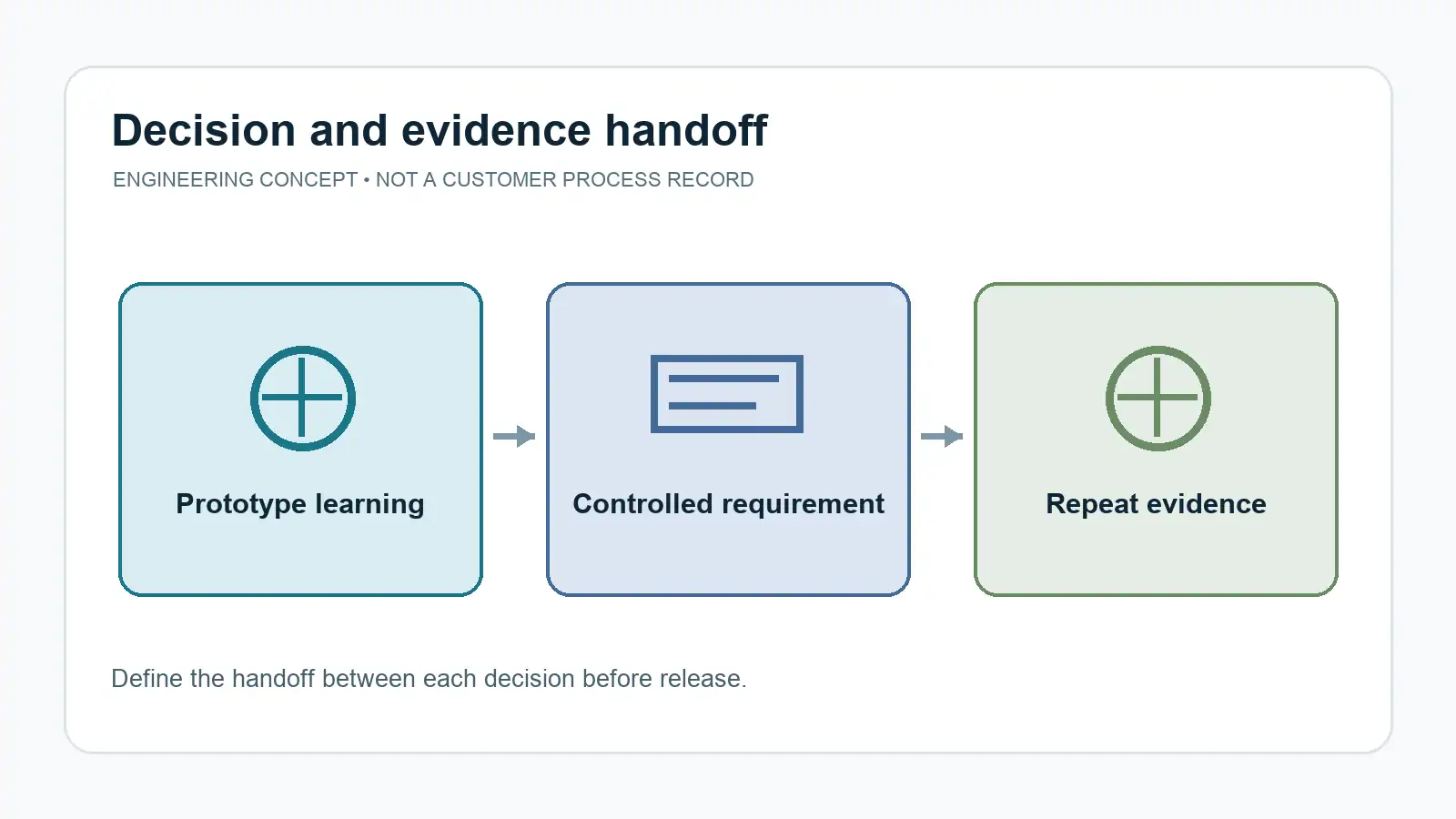
A good prototype proves that one part can be made and can reveal design problems. It does not, by itself, prove a repeatable production process. Before releasing a complex five-axis CNC part for recurring orders, freeze the product definition, separate deliberate prototype deviations from approved requirements, establish the inspection baseline, and define how changes will be reviewed. The handoff is a controlled decision, not simply a larger purchase order.
Separate learning parts from approval parts
Early prototypes often use available stock, temporary fixtures, manual deburring, extra polishing, or selective measurement to answer a specific engineering question. That can be entirely appropriate. The mistake is treating the resulting part as proof that the quoted repeat process will make and verify every requirement. Record which prototype characteristics were actually tested, which were waived, and which features were created by a nonrepeatable route.
State the prototype's purpose before asking for an inspection package. A fit-check part, a functional test part, and a production-representative first article answer different questions. If a prototype uses alternate material or omits a specified finish, note that explicitly so the next decision is not based on a false equivalence. For a regulated program, follow the applicable customer and contractual first-article requirements rather than calling every prototype check a formal FAI.
Freeze the design baseline
The handoff package needs a controlled drawing or model-based definition, revision, material and condition, finish, approved deviations, quantity assumptions, and a characteristic list. Identify whether a 2D drawing or 3D model governs each requirement. Mark the functional interfaces and datum scheme, including relationships across faces that may be affected by a setup transfer. If two files conflict, engineering must resolve the conflict before production release.
Review prototype changes one by one. A hole moved for assembly clearance may change fixture access, coating masks, or gauge design. A tolerance tightened after a bench test may require a different operation or inspection method. A cosmetic change can alter deburring or finishing time. Ask the manufacturer to re-evaluate the route and quote against the released revision rather than assuming the prototype program can be reused unchanged.
Define the repeatable process boundary
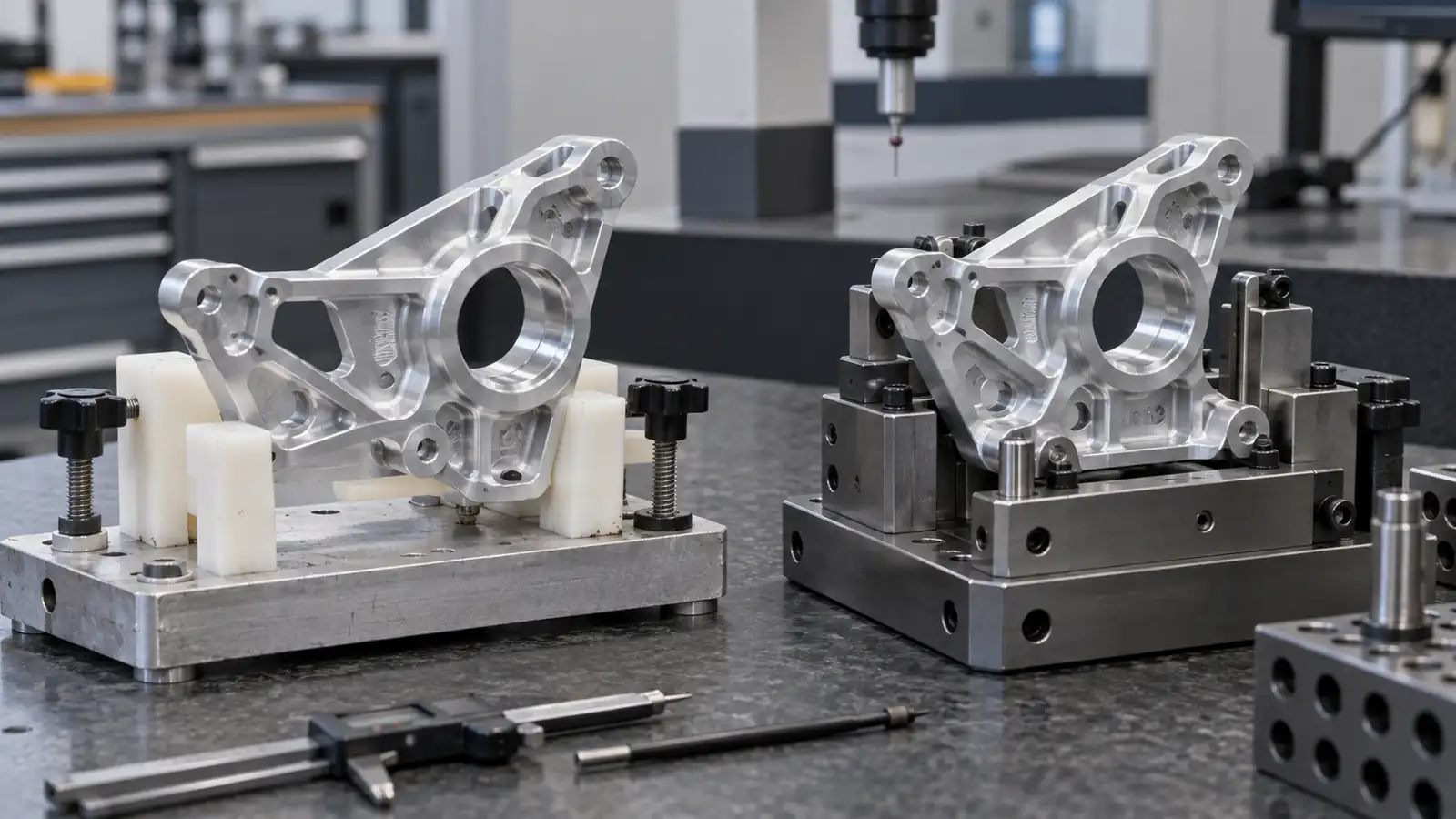
Ask which elements of the prototype route will be retained: stock form, setup references, fixture contact points, roughing and finishing order, tools, outside processes, cleaning, and packaging. A five-axis machine may reduce the number of re-clampings for some geometry, but it cannot guarantee one setup or eliminate deformation. If tight cross-face position or profile controls drive the part, ask how the supplier will preserve and verify the datum relationship after every transfer.
For thin walls or asymmetric stock removal, discuss how residual stress or cutting forces could affect the final condition. If the supplier proposes a new fixture for production, a passing prototype in a different fixture does not validate the new one. Decide whether a pilot lot or first production run should be inspected more broadly to test the proposed process. The sampling plan should match feature risk and volume, not an arbitrary universal percentage.
Outside finishing is a common break in the handoff. Specify the required condition for dimensional acceptance, masked surfaces, threaded or electrical-contact features, and who measures after finish. A pre-finish dimension may not guarantee a post-finish fit. Ask the finishing supplier's capability to be evaluated for the actual material and geometry; do not infer it from a generic process name.
Agree on evidence before the first repeat order
Create a characteristic-to-method matrix. For each critical feature, record the revision, nominal or geometric requirement, datum reference, stage of measurement, method or gauge, frequency, record, and acceptance authority. On-machine probing may help control a process; independent final inspection may still be needed. A CMM report is not self-explanatory unless its alignment, characteristic IDs, and evaluation basis match the released definition.
The first production run can be used to check whether the released process works under normal conditions. If a formal FAI is required, SAE AS9102C specifies a documented approach for aerospace programs; confirm the applicability and customer additions rather than using the name as a generic synonym for first-off inspection. For nonregulated work, define a right-sized first-article report in the purchase requirements.
Control changes after approval
Specify what requires buyer notice or approval: drawing revision, material source or condition, process route, fixture, program, critical tool, outside processor, inspection method, and site of manufacture. Not every tool replacement needs customer approval, but changes that can alter the validated result deserve a defined review. Include the handling of nonconforming material, rework, concessions, and retained records in the purchasing documents.
Keep the first-accepted-part record linked to its revision and manufacturing route. A repeat order should not rely on a folder named “final” with no change history. Lot identity, material certificates where required, and finish records should be traceable to the shipment according to the agreed scope. The buyer should also identify who approves a deviation and whether approval is limited to a lot or becomes a design change.
Practical handoff checklist
Before placing the first repeat order, confirm:
- The product definition and governing revision are unambiguous.
- Prototype deviations and untested characteristics are listed.
- Critical features have a feasible machining and inspection method.
- The production fixture and route are identified, including outside work.
- Acceptance condition before or after finishing is clear.
- First-run evidence, sampling, and approval gate are agreed.
- Change notification and nonconformance paths are documented.
If any item is open, assign an owner and an approval date. The right decision may be to run a controlled pilot lot rather than to issue a full repeat order. A pilot does not substitute for clear requirements; it tests a route against them.
For a non-confidential initial conversation with JIZAO, describe the part family, material, expected release sizes, prototype status, and the few interfaces driving the handoff. Ask which information is needed for a process and inspection review before transmitting controlled drawings through an approved channel. No claim here establishes that JIZAO has already qualified your specific production process.
Frequently asked questions
Can I use a passing prototype CMM report as production approval?
Only if the report covers the released revision and the relevant manufacturing condition, and your approval procedure accepts it. A prototype made with different material, fixture, finish, or process may need further evidence.
Must the supplier use the same machine for repeat orders?
Not necessarily. The important issue is whether a machine or route change affects approved characteristics and triggers the agreed review or requalification.
When should the first repeat lot be inspected more heavily?
Consider it when the process, fixture, material condition, finish, or critical requirement differs from the prototype. Define the extent by feature risk and contract, not by a blanket rule.
References
- SAE AS9102C, First Article Inspection Requirements
- ASME Y14.5-2018 (R2024), Dimensioning and Tolerancing, where the released drawing specifies that system.