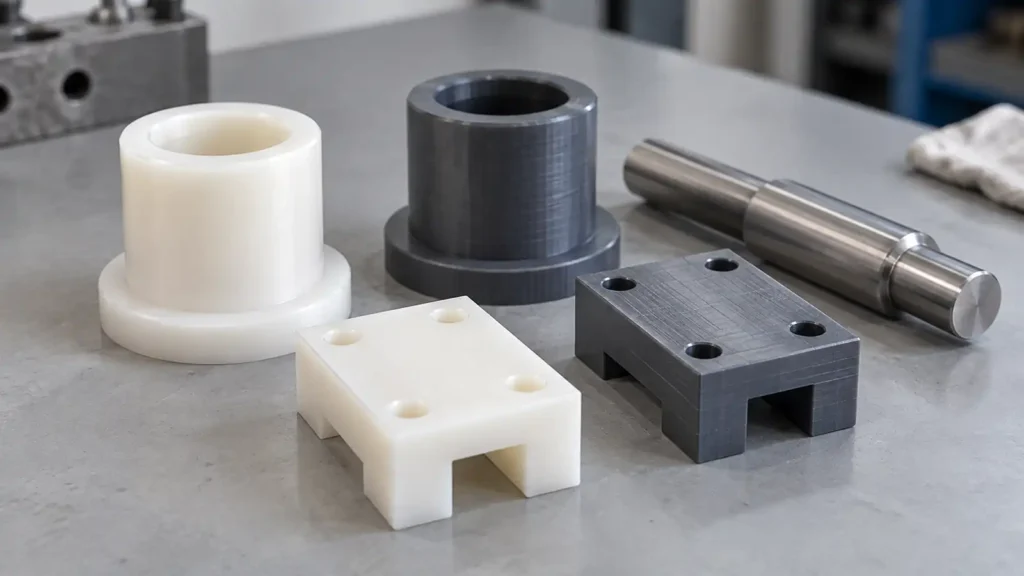
Choose between POM (acetal) and nylon for a machined part from the specific grade and service condition, not a family-level claim that one plastic is “more precise.” Moisture uptake, temperature change, load and machining-induced stress can move a functional dimension after inspection. POM-C is often selected when lower moisture uptake helps a close fit; nylon may be attractive for wear, toughness or other duties, but its grade and conditioning state matter. The drawing should define the fit in the state in which the assembly must work.
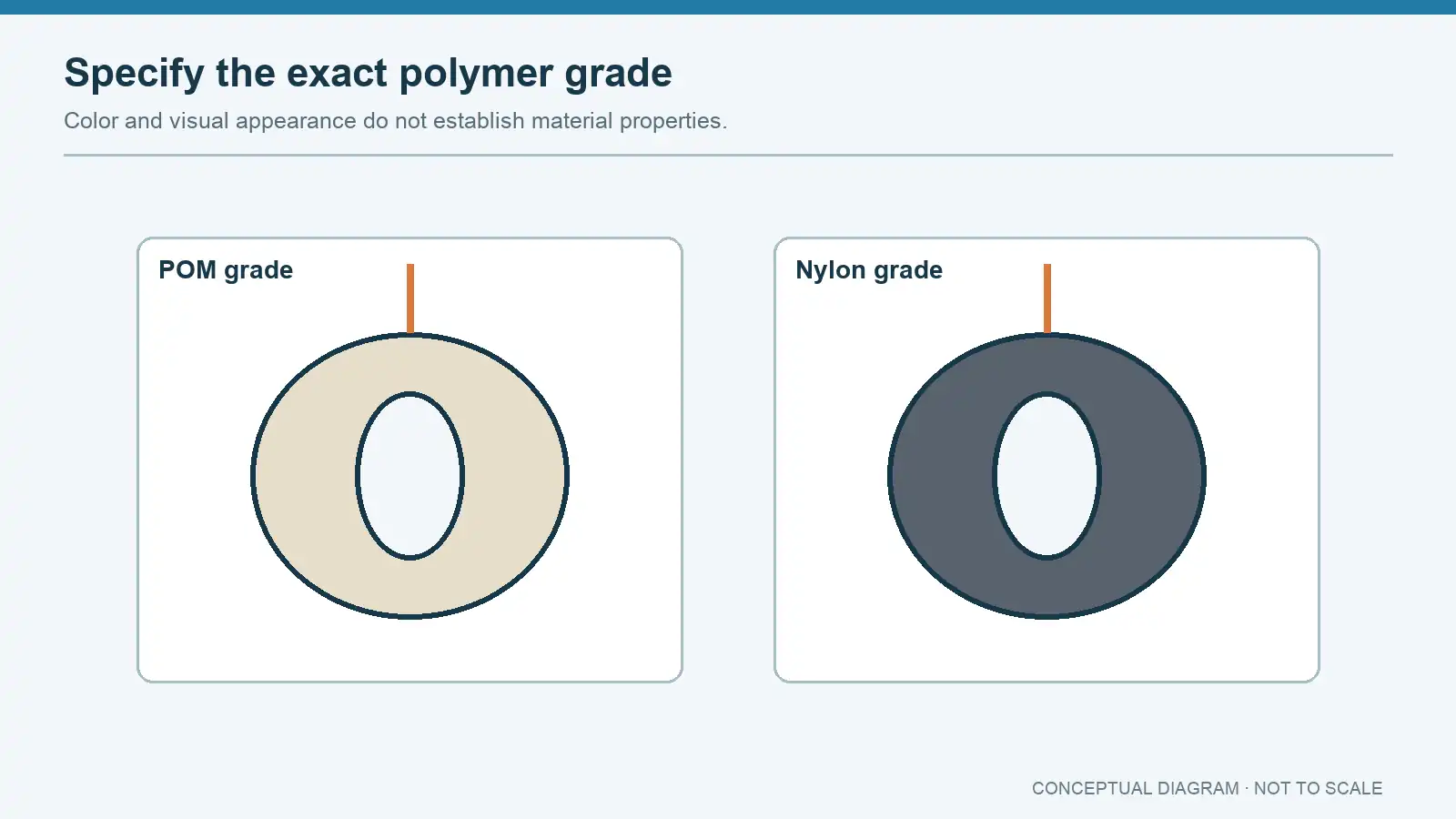
Compare named grades, not color or material family
“Nylon” can mean PA6, PA66, PA12, cast grades, filled grades and others. “Acetal” can mean POM homopolymer or copolymer with different stock forms and additives. The supplier datasheet is the starting point for water absorption, thermal expansion and mechanical properties; a generic comparison chart is not a purchasing specification. For example, Ensinger publishes separate data for TECAFORM AH natural POM-C, TECAST T natural PA6 and TECAMID 612. Their moisture data and service descriptions are not identical, showing why the exact grade must be named. These are manufacturer examples, not JIZAO material guarantees or proof that every POM grade outperforms every nylon grade.
An appearance photo cannot establish polymer identity. Specify manufacturer/grade or an approved equivalent, stock form, color only if functionally necessary, and any material certification needed. If the grade can change, require an engineering comparison of property data and mating-part fit, not a substitution based on the word “nylon.”
Translate moisture exposure into fit risk
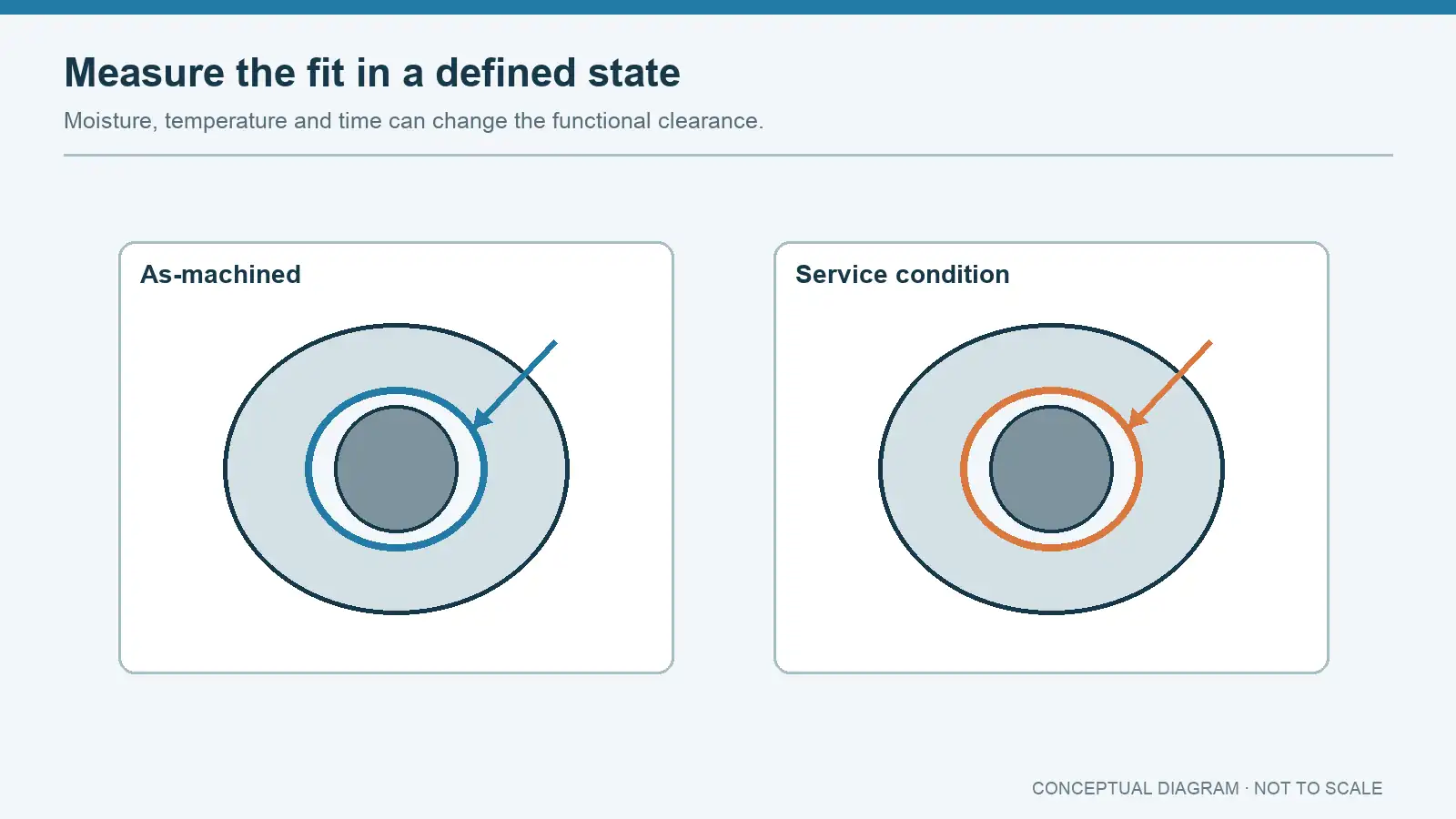
Nylon grades may absorb enough water for dimensions and mechanical properties to change between a dry shop and a humid operating environment. POM grades also absorb moisture, generally differently; neither material is dimensionally inert. Ensinger's PA612 description explicitly positions that grade as lower-moisture than some other nylons. The direction and magnitude of fit change depend on grade, initial moisture content, geometry, wall thickness, time and environment. A datasheet mass-uptake value is not a direct dimensional growth allowance for an arbitrary part.
For a sliding guide, bushing or press-fit insert, ask what happens at the driest and wettest expected service conditions. Is the mating part metal? Does reduced clearance create binding, or does increased clearance create looseness? Decide whether the part is inspected immediately after machining, after conditioning or at a controlled reference state, and whether assembly occurs in that same state. Curbell's plastic-machining guidance notes that high-moisture plastics may require conditioning before processing; the correct conditioning protocol is material- and application-specific.
Temperature, load and machining stress add another dimension
Both POM and nylon expand with temperature, often much more than a mating metal. A close room-temperature fit can change in service. Sustained load may introduce creep or relaxation, and asymmetric stock removal can release stress or warp a plastic component. Curbell's dimensional-stability guidance lists moisture, temperature, residual stress, creep, design and machining as interacting factors. That is why a blanket “±” note without state and function can be misleading.
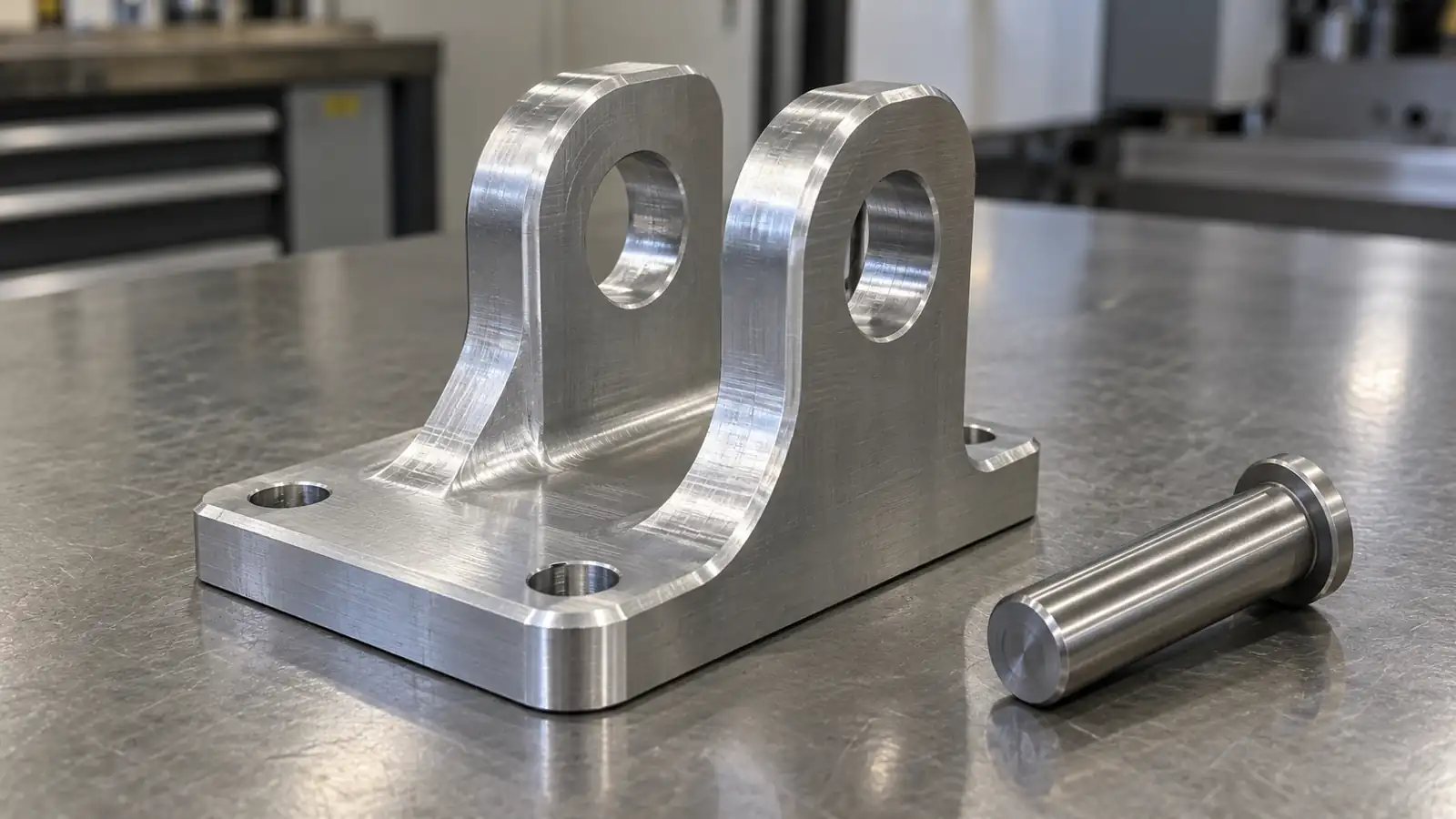
For a bearing-like polymer sleeve, distinguish an inner running clearance from an outer retention fit; they may move in different directions as the assembly warms or conditions. Do not transfer a fit table intended for metal parts without checking the polymer grade, mating geometry and load. If the allowable clearance window is narrow, confirm it with the product engineer through worst-condition analysis or representative testing rather than guessing a CNC tolerance.
Specify the measurement state and the acceptance characteristic
The RFQ drawing should state the controlled feature, datum system, material grade, conditioning or reference environment, and whether a dimension is checked free-state or assembled. A caliper can screen an accessible size, but a bore's form or a mating alignment may need a bore gauge, CMM or functional gauge appropriate to the tolerance and compliance of the plastic. Gentle fixturing matters: excessive measuring force or clamping can deform a flexible part and make a number look stable when the part is not.
If the supplier proposes a different grade, ask for its datasheet and a fit review under the same dry/wet and cold/hot conditions. If a polymer part is dimensionally unstable after aggressive machining, review stock form, machining sequence, heat input and conditioning before simply tightening the drawing tolerance.
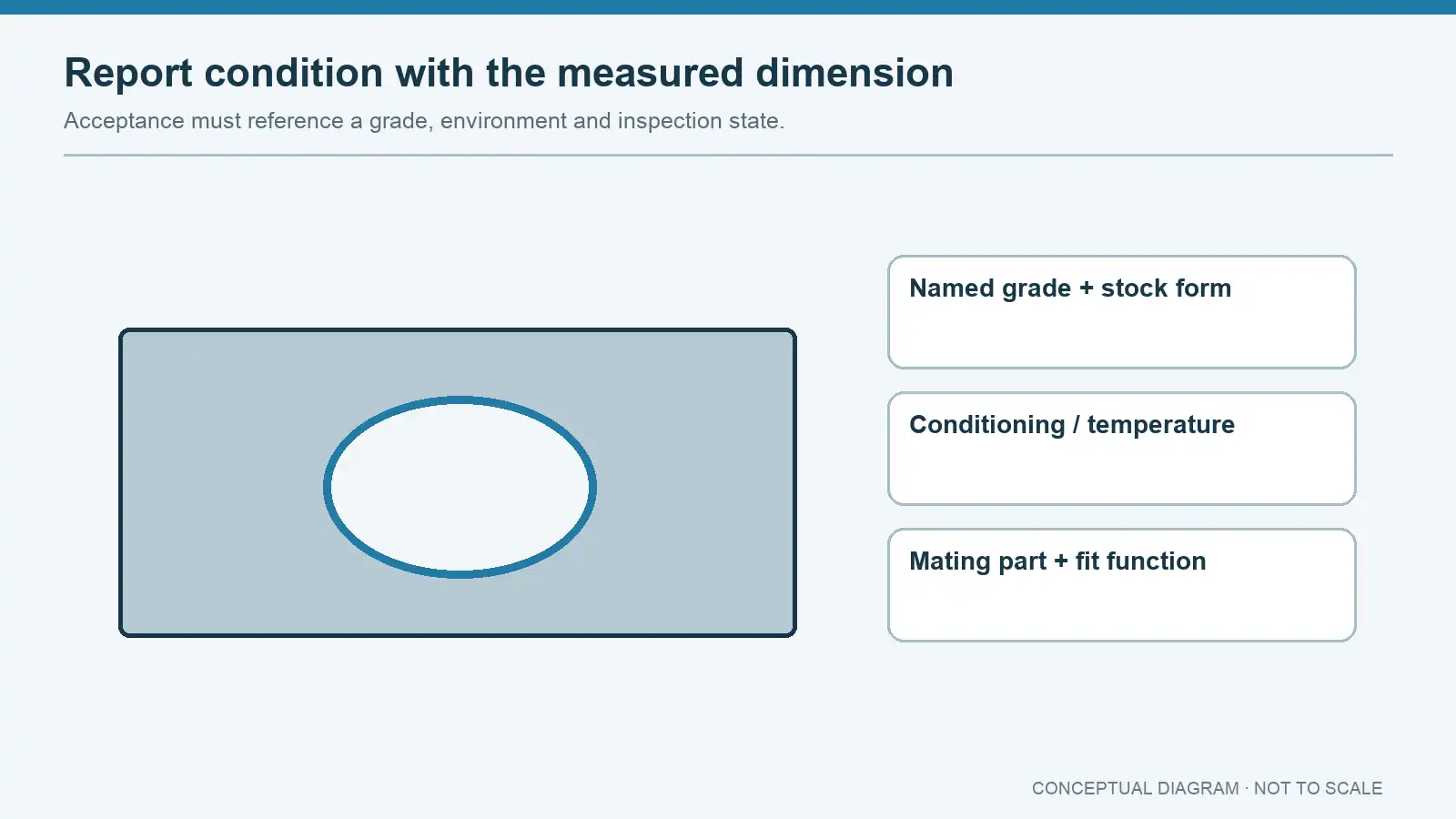
Send the model and revision-controlled drawing, named grade or permitted alternatives, mating component, functional clearance/interference range, service humidity and temperature range, load/duty, assembly state, inspection state and batch quantity. JIZAO can review CNC geometry and quote a defined material/inspection route; material behavior in the final assembly still needs grade-specific engineering validation. The useful question is not “POM or nylon?” in isolation, but “which specified material keeps this interface functional from manufacture through service?”