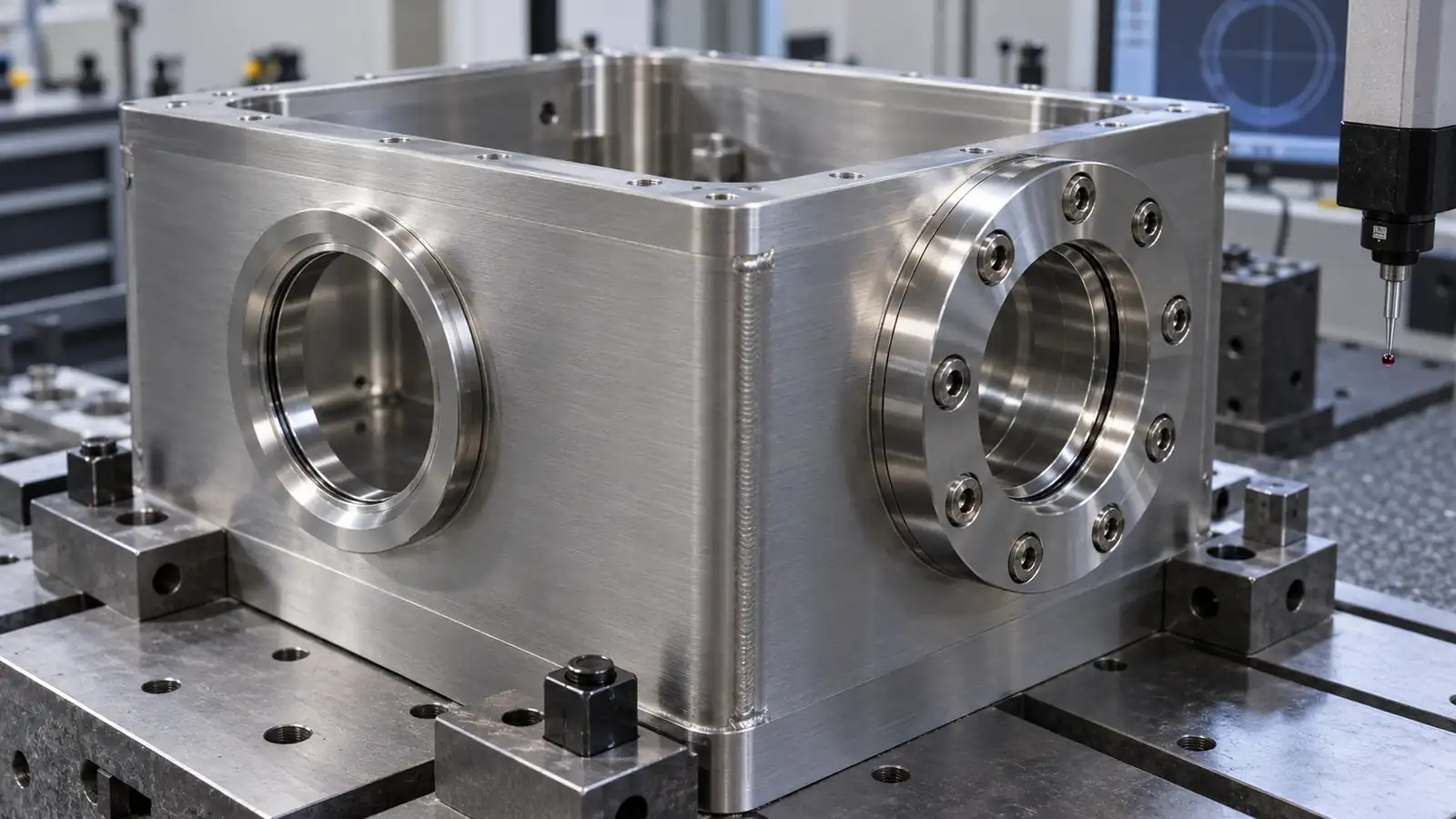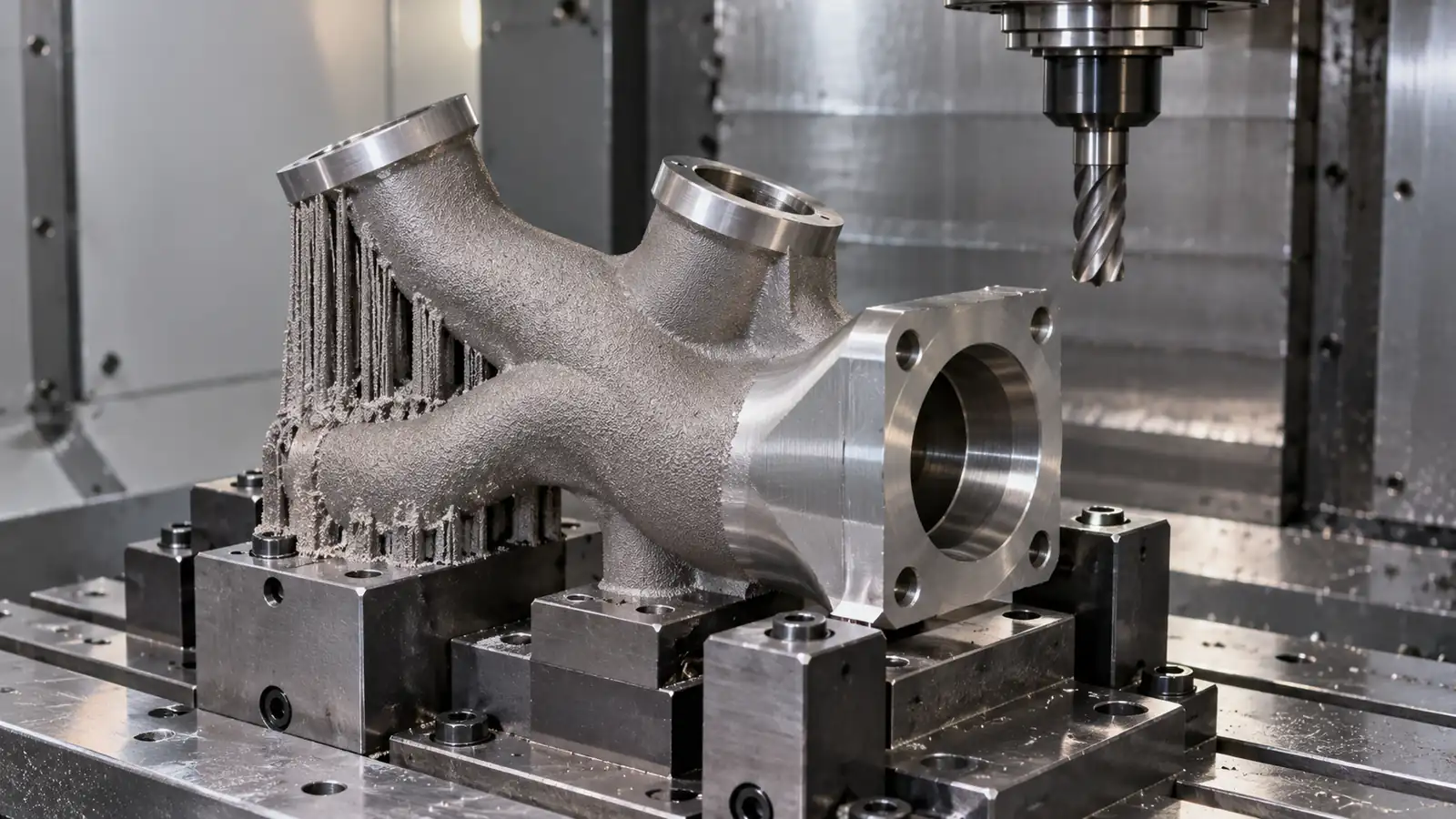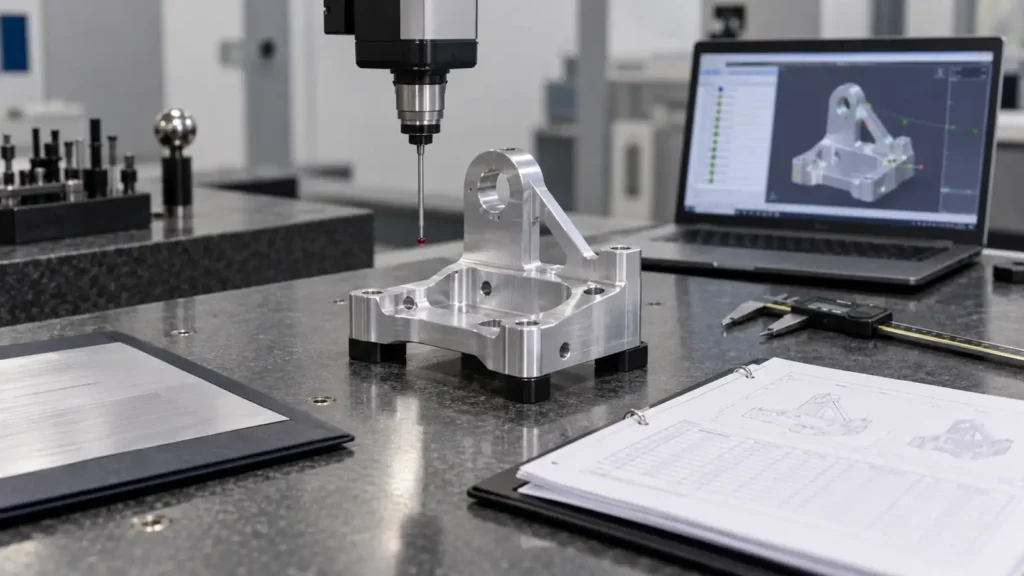
“First article inspection required” is not a complete purchase requirement. It can mean a quick first-off dimensional check, a ballooned drawing with results, a customer form, or a formal aerospace first article package. Those deliverables differ greatly in time, evidence and approval responsibility.
Define the purpose and scope before quotation so the CNC supplier can plan production, measurement and document control together.
Quick answer
State whether you need a production first-off check, a full dimensional report, a customer-specific FAI, or a formal standard-based package. Identify the governing revision, product-definition baseline, production process basis, characteristic list, required certificates, sample quantity, approval gate and rules for partial or repeat FAI.
FAI is not one universal deliverable
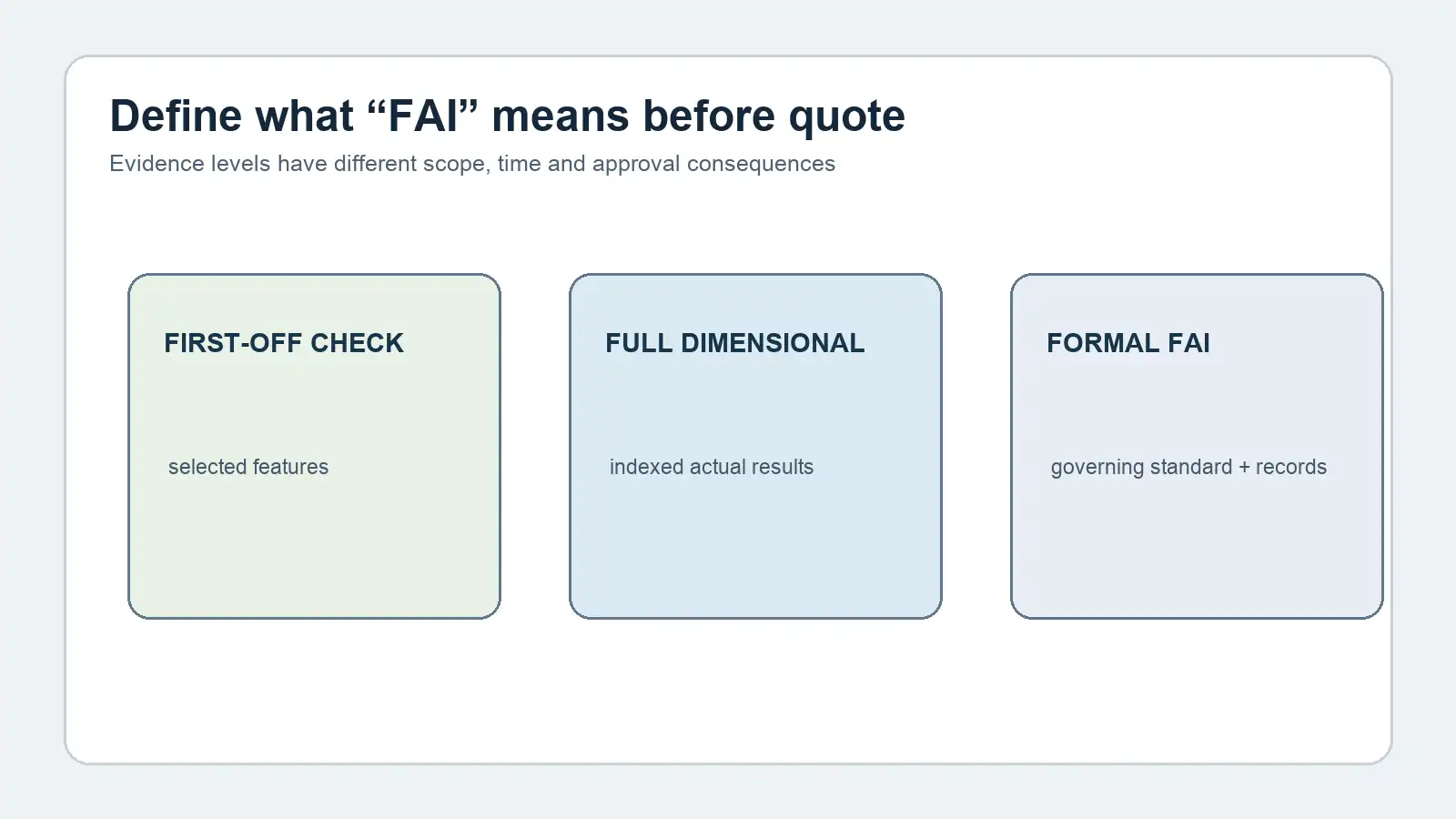
A practical buyer vocabulary separates at least three levels:
- First-off verification: confirms selected dimensions on the first part before the lot continues.
- Full dimensional report: records results for drawing characteristics, often with a ballooned drawing.
- Formal FAI package: follows a specified standard or customer procedure and includes defined forms, accountability and supporting records.
SAE AS9102C, revised in June 2023, establishes requirements for performing and documenting aerospace FAI. SAE states that these requirements complement rather than replace customer, statutory and regulatory requirements. Do not request “AS9102” casually if the program does not need that formal scope; do not accept a generic dimensional sheet when the contract requires AS9102C.
For non-aerospace CNC work, a customer can define a fit-for-purpose report without claiming AS9102 compliance. The purchase order should make that distinction explicit.
Define the production basis
An FAI is most useful when the inspected item represents the intended production process. Record the applicable drawing and model revisions, material, CNC program or controlled process reference, tooling and fixtures, special processes, manufacturing location when required, and configuration of the inspected part.
A prototype made with temporary tooling may prove geometry but not necessarily validate the recurring production route. Conversely, a production first article may require the same material form, finishing source and inspection method planned for the lot.
Agree on the hold point. Must machining stop after the first piece? Can the supplier continue at risk? Does approval occur before coating, after coating, or after complete assembly? A missing answer can turn a useful quality gate into schedule confusion.
Build characteristic accountability
The report should make it possible to connect every required characteristic to its result and method. A ballooned drawing or indexed product-definition list is a common bridge.
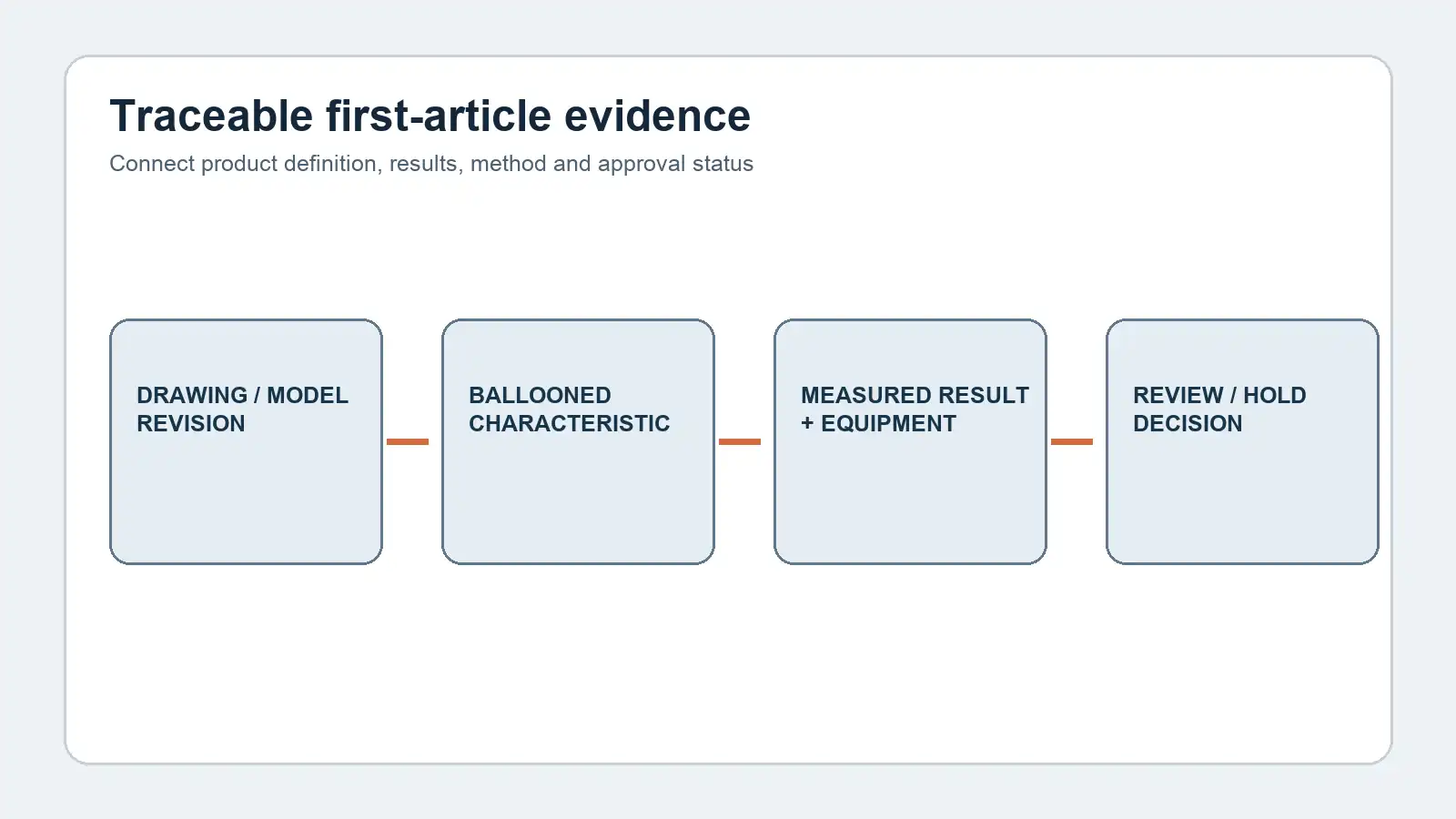
For each characteristic, define as applicable:
- requirement and tolerance;
- measured or verified result;
- pass/fail status;
- measurement method or equipment identity;
- number of results when a pattern contains multiple features;
- notes for derived, visual, material or process characteristics;
- nonconformance reference and disposition status.
Do not collapse a multi-hole pattern into one unexplained value if the requirement expects individual or pattern-level evidence. Do not report “pass” for a numerical characteristic when the contract requires actual results.
Include material and special-process evidence intentionally
Depending on the purchase requirement, the package may include material certificates, heat-treatment records, coating or anodizing certificates, passivation records, hardness results, functional test reports, approved supplier information or certificates of conformity.
Ask for records that protect real risk. Requiring every possible certificate can increase cost and review time without improving the decision. Conversely, dimensional results alone cannot prove alloy, heat treatment or an outsourced finish.
If traceability is required, state whether records must connect to the raw-material heat or lot, part serial or batch, special-process lot and inspection report. Do not assume a photo of a certificate is sufficient evidence.
Measurement planning belongs before production
The drawing characteristic determines the method. Calipers may be suitable for some noncritical sizes; bores, profiles, surface texture, threads and complex GD&T may require different equipment. A CMM is not universal proof. Datum simulation, probe access, sampling strategy, temperature and measurement uncertainty affect the result.
On-machine probing can support setup and process control, but it is not automatically independent acceptance evidence. See on-machine probing versus CMM inspection and our guide to GD&T and CMM planning.
If a characteristic cannot be measured after assembly or coating, establish an in-process inspection step and the evidence needed to retain traceability.
Full FAI, partial FAI and repeat triggers
Formal programs define when a new or partial FAI is required. Common triggers can include product-design change, manufacturing-process change, tooling or location change, lapse in production, or corrective action—but the applicable standard and customer procedure control the decision.
The RFQ should say who decides whether the change affects characteristics and how the delta is documented. Do not automatically rerun an entire package for every minor administrative revision, and do not reuse an old FAI after a material process change without review.
What to put in the RFQ or purchase order
Include:
- deliverable level and governing standard or customer procedure;
- form template and language;
- drawing, model and specification revisions;
- part quantity and FAI sample quantity;
- ballooned drawing requirement;
- actual-result versus pass/fail reporting rules;
- material, special-process and test certificates;
- equipment or calibration-traceability expectations;
- approval authority and production hold point;
- partial/repeat FAI triggers;
- file format, naming and submission route;
- retention period and confidentiality controls when applicable.
For model-based definition, specify which annotated model, data set and drawing notes form the authority. A STEP file without product-manufacturing information may not contain the complete requirement. See what to send for CNC quoting.
Common failure modes
Requesting FAI after the quote
The added programming, inspection and documentation burden may change cost and lead time. Define it at RFQ stage.
Inspecting a nonrepresentative prototype
Document deviations from the planned production process and decide whether later validation is needed.
Missing revision control
A complete-looking report can be invalid if it refers to the wrong model, drawing, material or specification revision.
Treating FAI as process capability
One conforming article does not prove the process distribution or future lot capability. Recurring production may need control plans, sampling, SPC or capability evidence appropriate to the risk.
Treating paperwork as product acceptance
Evidence must remain connected to the physical part and its configuration. Resolve nonconformances and missing records before approval.
FAQ
Is a full dimensional report the same as AS9102C FAI?
No. A dimensional report can be one component of evidence, but AS9102C defines a broader formal process and documentation scope.
Does FAI require only one part?
The required sample and data depend on the governing standard, customer requirement and feature pattern. State the expectation explicitly.
Can production continue before FAI approval?
Only if the buyer's risk decision and purchase terms allow it. Define the hold point before work begins.
Does a conforming first article guarantee the full lot?
No. It verifies the inspected article and production basis within the defined scope. Lot control and ongoing capability require additional planning.
Final RFQ check
Before releasing the order, confirm the required evidence level, current product-definition baseline, representative production basis, complete characteristic accountability, certificate scope, approval gate and repeat triggers. A clear FAI requirement protects both the buyer's decision and the supplier's production plan.