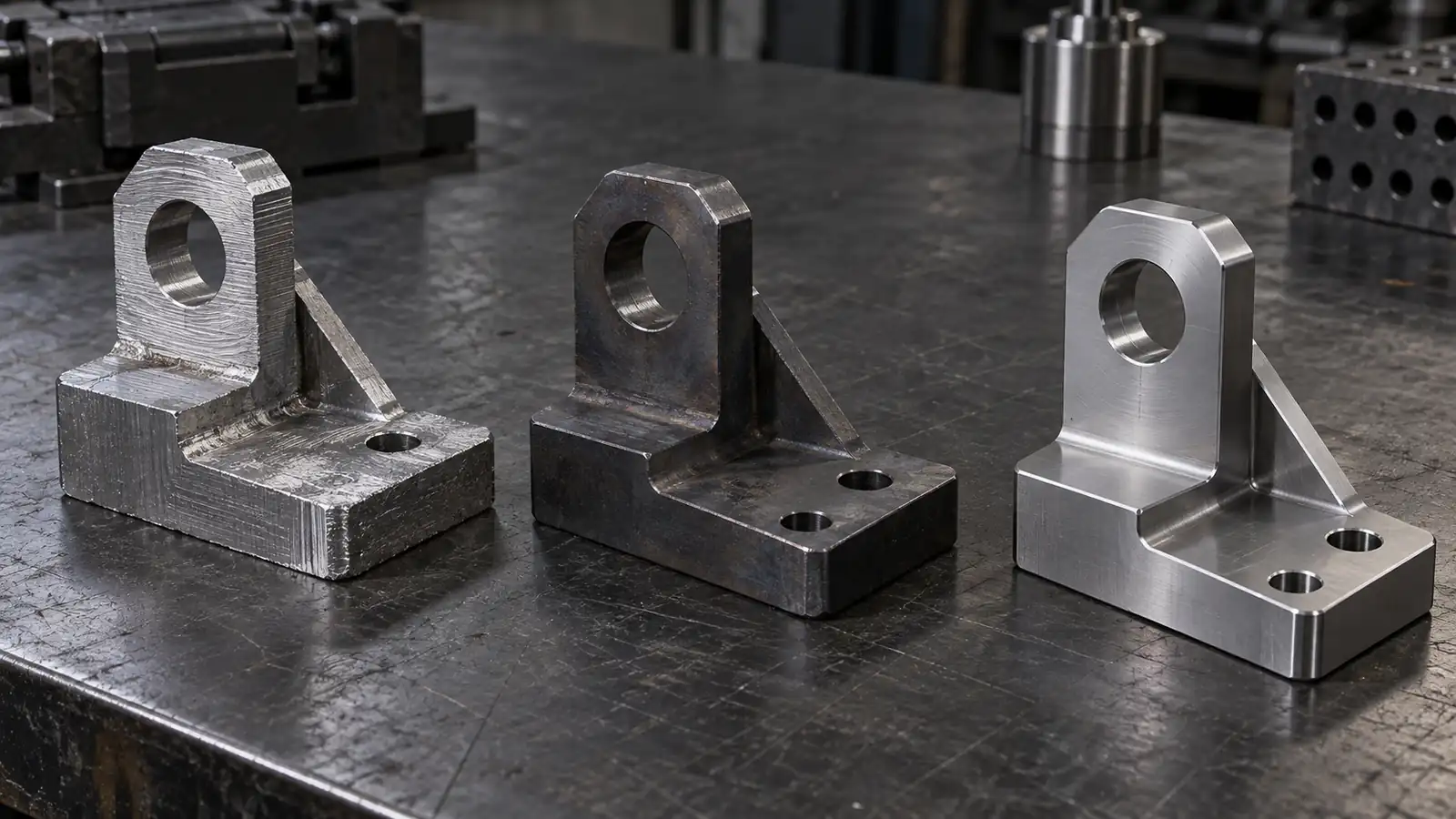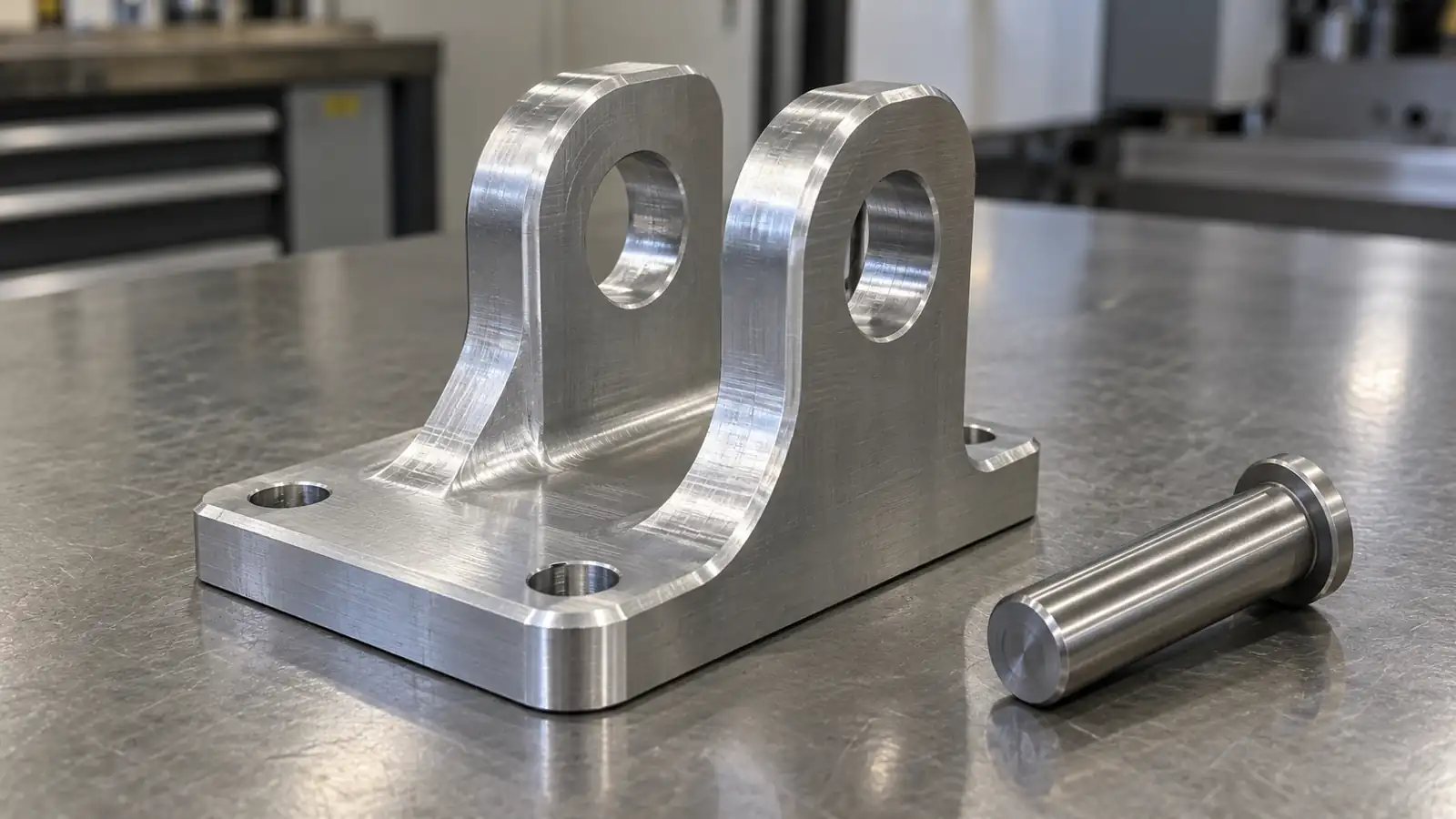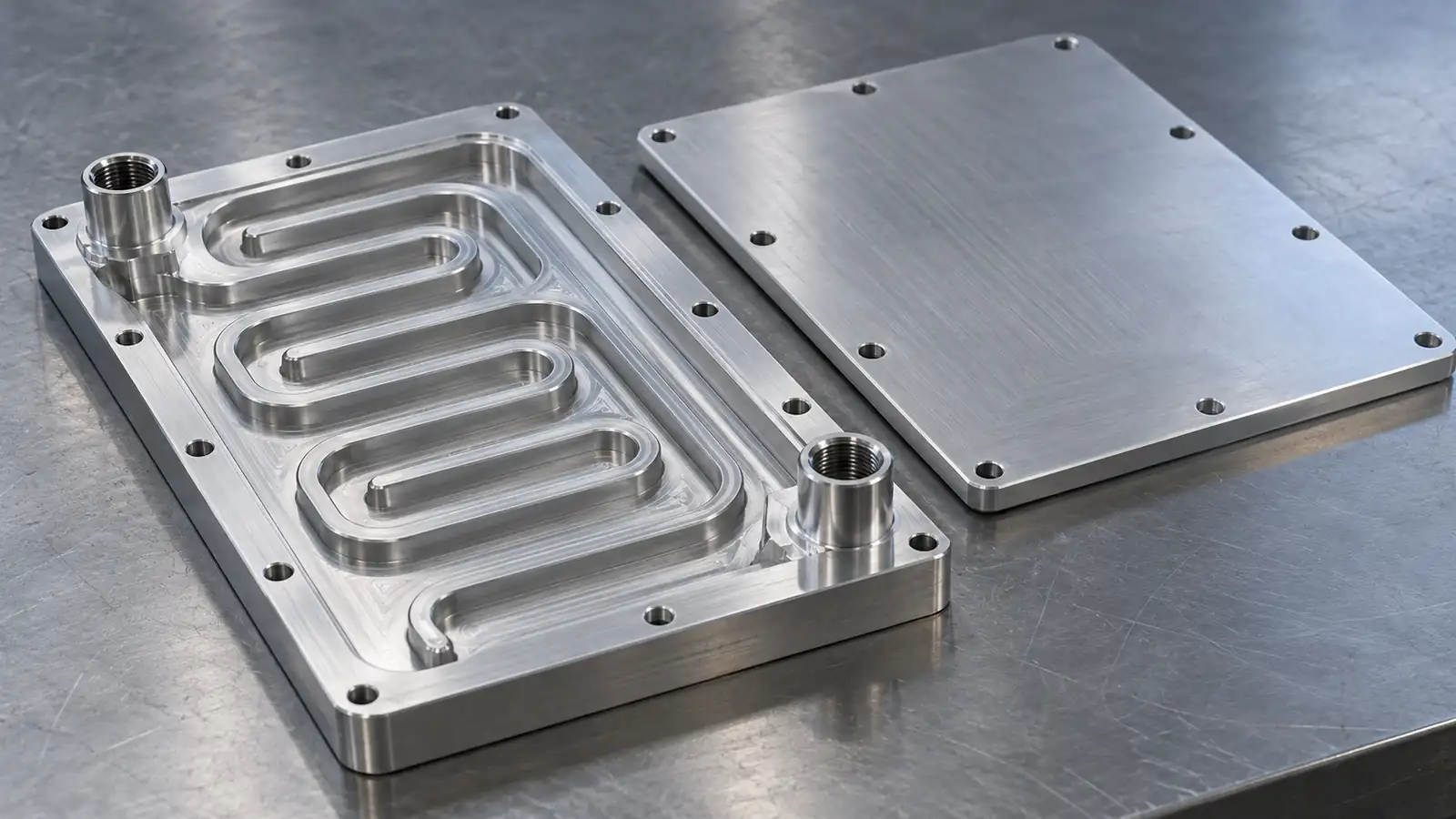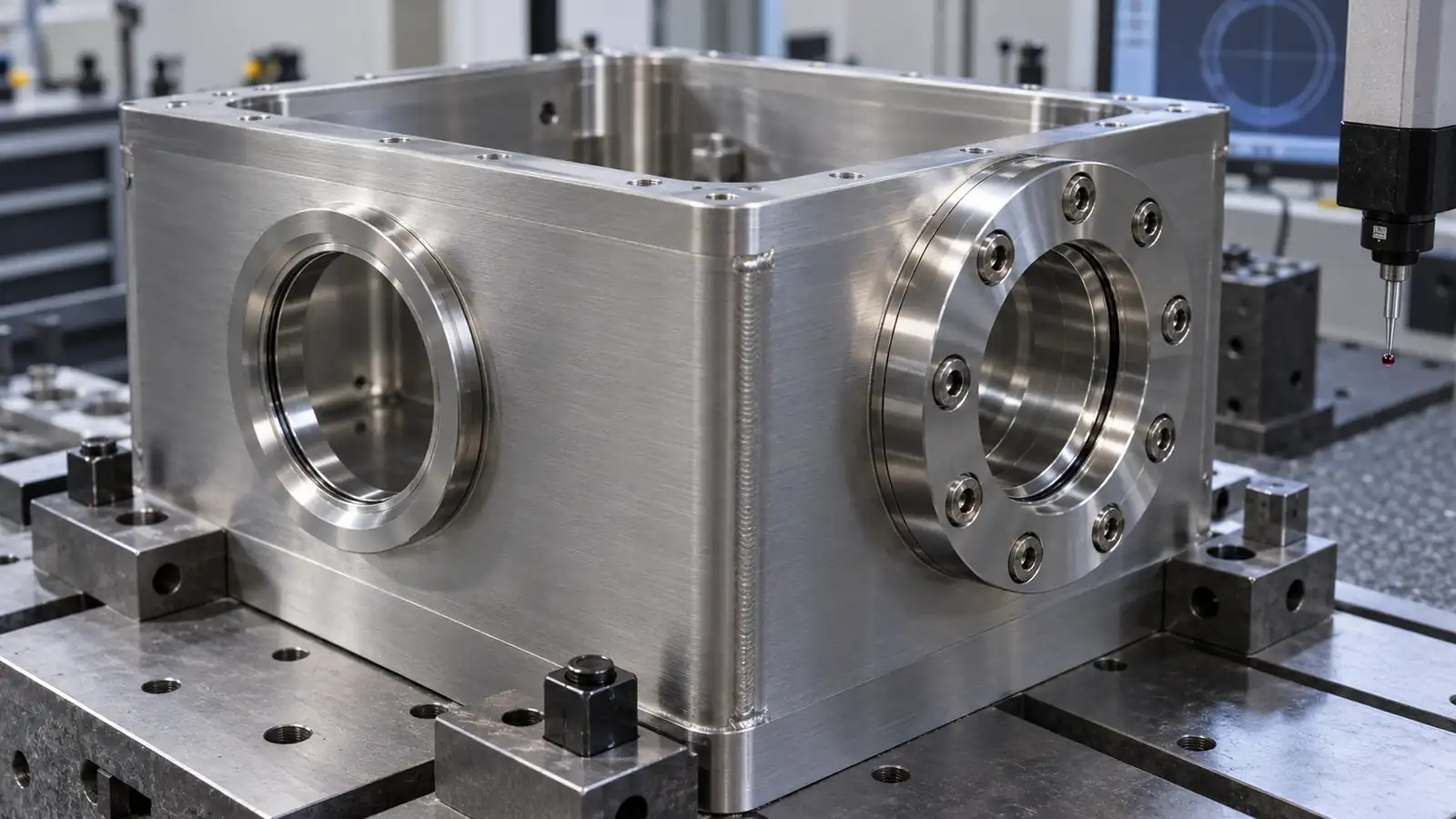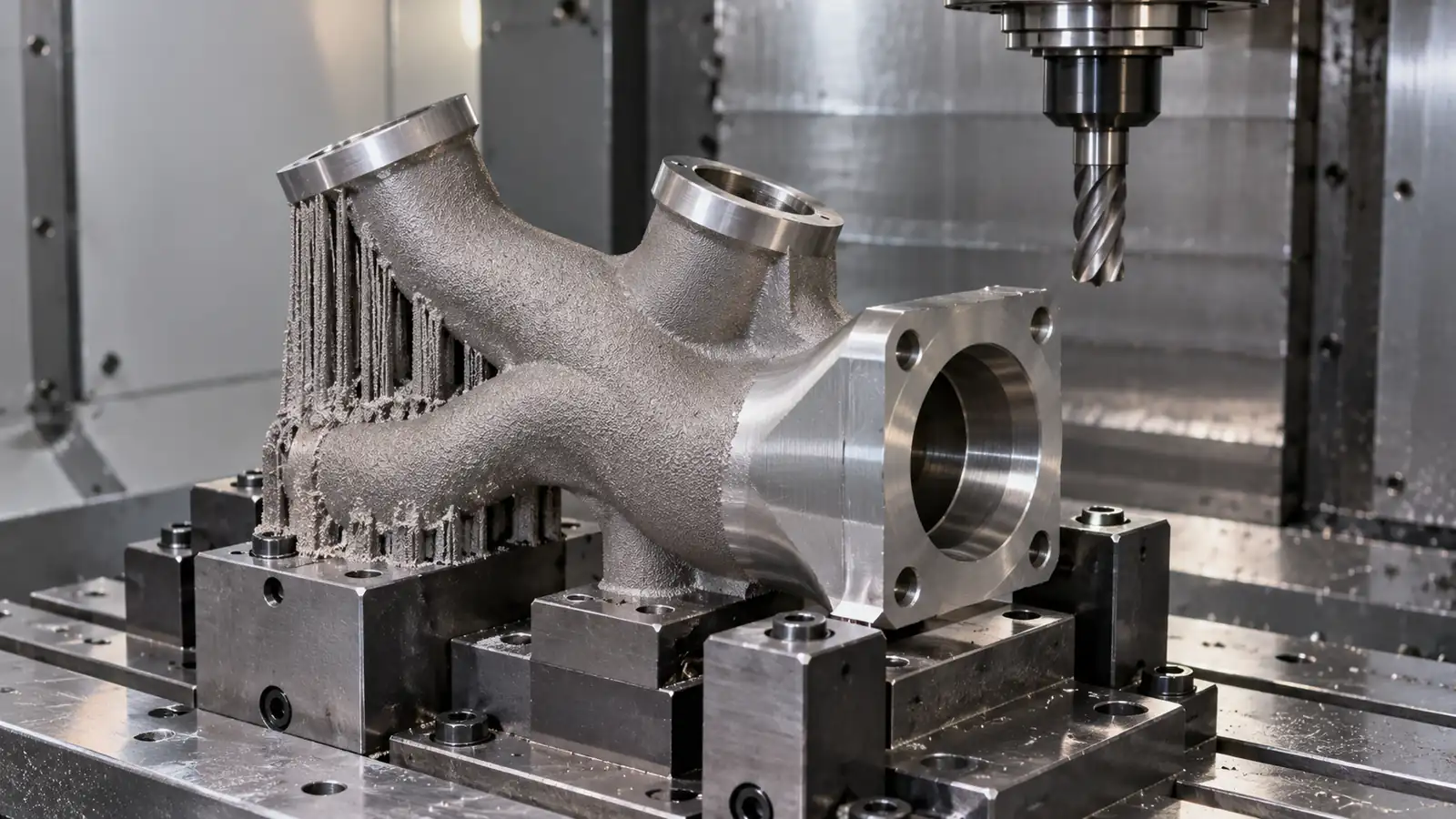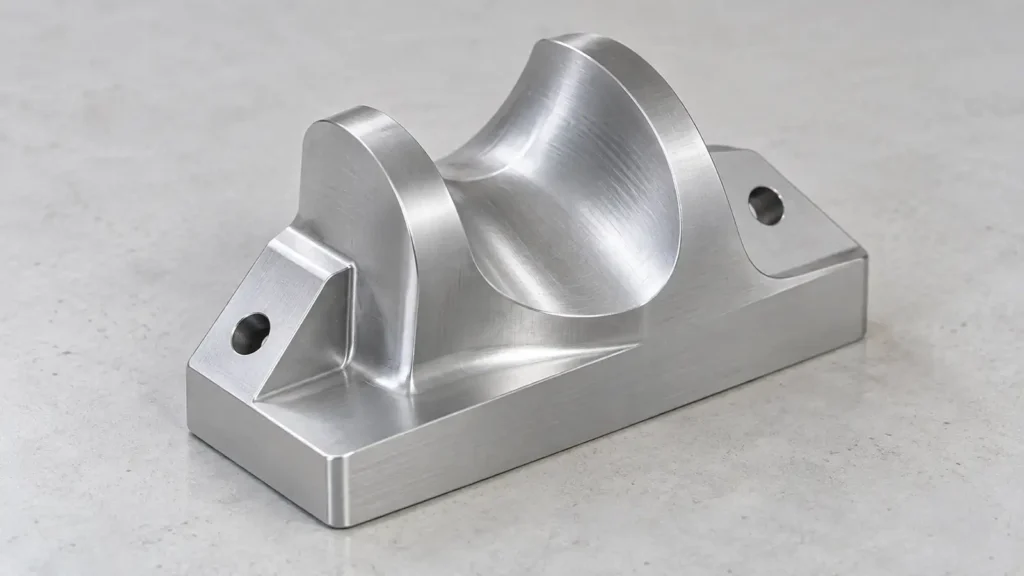
AI-generated conceptual engineering visual of an illustrative component, not a customer part or JIZAO manufacturing evidence. Its appearance alone does not establish a need for simultaneous five-axis machining.
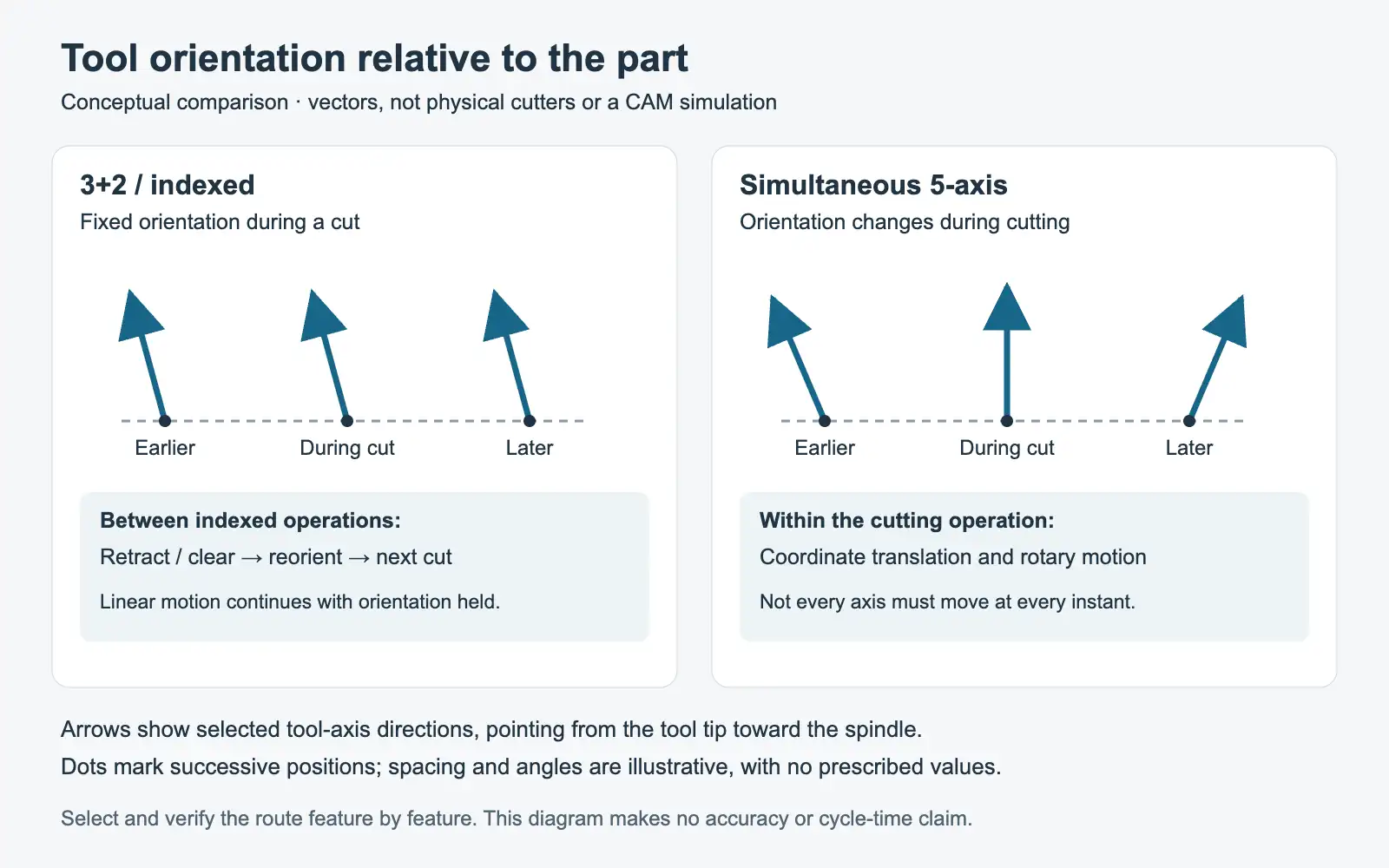
The practical difference between 3+2 and simultaneous 5-axis machining is whether the tool orientation relative to the part stays fixed during a cutting operation or changes as the tool follows its path. Start with the access needed for each feature, then ask the supplier to justify the proposed strategy. A complicated-looking part does not, by itself, establish a need for continuous five-axis motion.
This guide explains the distinction and provides a buyer’s review checklist. It is general process guidance, not a claim about a particular supplier’s equipment or a guarantee of accuracy.
What does 3+2 machining mean?
In 3+2, also called positional or indexed five-axis machining, two rotary axes establish the tool orientation relative to the part. That orientation is held while the linear axes perform the machining operation. The machine can then index to another orientation for another operation. Angled holes and features approached from several directions are common reasons to consider this method. Autodesk’s five-axis overview distinguishes this fixed-orientation approach from simultaneous machining.
The word “positional” describes the tool-axis strategy, not the quality of the finished part. Buyers should avoid treating it as shorthand for a lower manufacturing grade.
What changes with simultaneous five-axis machining?
Simultaneous five-axis machining coordinates linear and rotary movement so that tool orientation relative to the part can change during cutting. It does not mean that every axis must move at every instant of every operation. The relevant question is whether changing orientation serves the feature being machined. Autodesk’s machining overview
Ask the programmer to identify the specific surface or access restriction that requires this motion. “It is a five-axis part” is less useful than an explanation tied to marked features on the model.
Choose by operation, not by the name of the whole part
Autodesk’s strategy guidance recommends considering 3+2 before introducing simultaneous machining where it is unnecessary. It also describes different tool-axis controls for different finishing needs. That supports an operation-by-operation discussion, rather than a blanket specification that every toolpath must use simultaneous motion. Autodesk’s strategy guide
Use the following as questions for review, not as an automatic process-selection rule:
| Feature or requirement | Question to ask the supplier |
|---|---|
| Holes on several angled faces | Can each group be reached at a fixed orientation? |
| A curved surface | Is a fixed-axis path adequate, or must orientation change to address a specific restriction? |
| A recessed feature | Which part of the tool assembly limits access, and at what location? |
| A critical finished surface | How will the proposed path be checked against the drawing’s acceptance requirement? |
| Several different feature types | Which operations use indexing, which use simultaneous motion, and why? |
These questions keep the conversation tied to the design. They also make it easier to compare two quotations that describe their processes differently.
Do not assume that more axis motion means more accuracy
Autodesk’s strategy discussion identifies machine kinematics, mechanical errors, and thermal behavior as relevant to the result of simultaneous machining. Its guidance does not justify a universal claim that continuous five-axis motion always produces a better finish. Autodesk’s strategy guide
For a purchasing decision, request a proposed verification approach for the characteristics that matter to your assembly. A process label is not an inspection result. Equally, do not reject an indexed proposal merely because another supplier uses the phrase “full five-axis.” Compare both proposals against the same controlled drawing and the same acceptance criteria.
If your main concern is the relationship between features machined in different setups, treat that as a separate GD&T and CMM inspection planning review. It should not disappear inside a general debate about axis count.
A hypothetical review example
Imagine a component with mounting holes on angled faces and a separate sculpted external surface. This is an illustrative design-review scenario, not a JIZAO customer case.
Ask for two explanations. First, how would the supplier approach each hole group? Second, what tool orientation would be used over the sculpted surface? Do not insist that the answers use the same strategy. Request that any proposed change to the geometry or acceptance requirements be returned for design approval.
The useful outcome is a marked-up operation discussion with open questions assigned to owners—not an unsupported promise that one approach will be faster or more precise.
Questions to resolve before accepting the process proposal
- Which features drive the strategy selection?
- Which operations are indexed and which involve changing orientation during cutting?
- What access restrictions remain unresolved?
- What assumptions about stock, fixturing, and finishing affect the proposal?
- Which drawing characteristics will be verified, and what report is expected?
- Does the quotation identify any requested design changes or excluded requirements?
Keep answers with the same revision of the model and drawing used for quotation. If the design changes, ask whether the process explanation still applies.
Is simultaneous five-axis machining always necessary?
No. Choose it where its motion is justified by the operation, rather than as a default badge of quality. The final route needs supplier engineering review against the actual geometry and requirements.
For a five-axis machining review with JIZAO, begin with a nonconfidential engineering inquiry summarizing the component, material, quantity, and difficult features. Agree on an appropriate transfer method before sharing proprietary drawings. Ask for a part-specific review; this article does not establish machine availability, attainable tolerances, price, or delivery time.